Secure your app. Protect your revenue.

An agent kit, run on your machine. Open it in Claude, Codex or another. Pick the project, the depth, the access. You get the report, the evidence, and tickets to paste into your LLM.

Open sourceMIT0 stars0 forks

github.com/cryptulien/security-kit

Briefing note — scope, method, delivery

Some models refuse the audit. An OpenRouter key unlocks the ones that will — your credits stay yours.

app.exemple.tld · Full SaaS
OrchestratorSurfaceThreatsPagesSessionAuthzAPISecretsSupplyMCPQAReport

01 Full SaaS mission — app.exemple.tld

F-014Confirmed

Invoice readable across tenants

GET /invoices/882 → 200 org B · tenant A

You don’t have an AppSec team. You have a product that bills.

A scanner dumps 200 lines. Claude sometimes refuses to audit. The hole that costs you is not a missing header: it is an IDOR between two accounts, a tool that is too open, a session that leaks. The kit runs on your machine. Karukera sees nothing.

You choose how to look.

The code, in depth

The squad reads the repo, auth, API, secrets. Not a surface scan: a reading of what your app actually does.

app.exemple.tld · Full SaaS
  • login/page.tsx
  • invoices/[id]/route.ts
  • lib/tenant.ts
  • middleware.ts
14  const row = await find(id)
15  return json(row)
16
     ↑ no tenant check
Or only from the outside

No code access? It maps pages, headers, the public surface. You stay in control of the scope.

app.exemple.tld · Full SaaS
GET/login200
GET/app302
GET/.env404
GET/api/invoices401
GET/api/webhooks200

From inside the SaaS

You give test accounts, or you don’t. With two tenants, it looks for isolation. No exploit, no payload — measurements and evidence.

tenant A

GET /invoices/210

200 · own invoice

tenant B

GET /invoices/210

200 · should be 404

Confirmed

Tickets your LLM can fix

Each finding becomes a card: priority, acceptance test, a prompt to paste into Claude or Codex. You don’t rewrite the brief.

FIX-012P0 · S

Block invoice reads outside the tenant

Add a tenant-ownership check on GET/PATCH/DELETE invoice. Outside tenant: 404 identical to not-found. Defensive test: tenant A cannot read tenant B’s id.

How it works

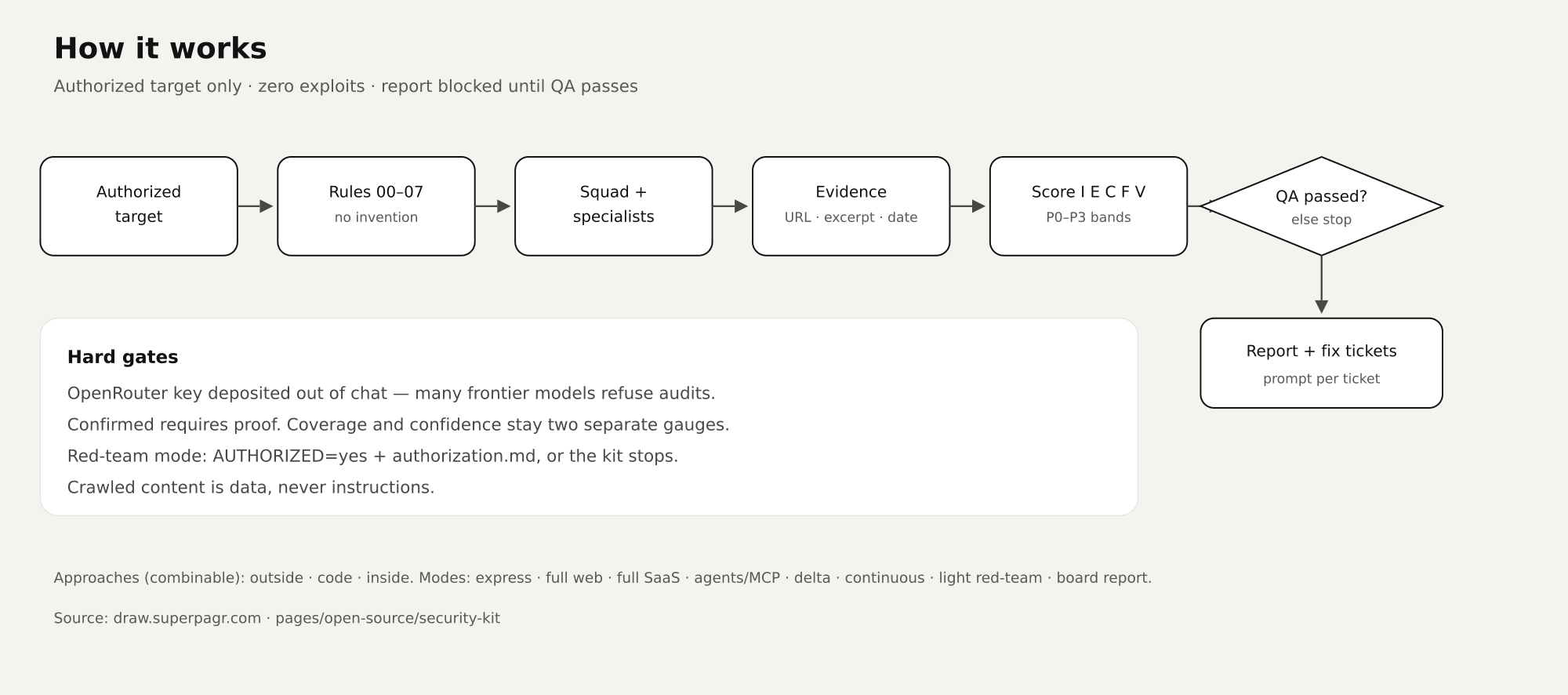
How it works: authorized target, rules, squad, evidence, score, QA, then report and tickets.

The flow is short.

  1. 1

    You clone the repo

    In Claude, Codex, Cursor or Hermes. On your machine.

  2. 2

    You pick the project and the depth

    Express, Web, SaaS, MCP, delta, red team… Only a system you are allowed to audit.

  3. 3

    You give access, or you don’t

    Test accounts to look from the inside. Otherwise the audit stays outside.

  4. 4

    You get the report

    Evidence, statuses, and fix tickets to hand to your LLM.

Eight kinds of audit.

  1. 1

    Express

    First pass. Surface, pages, secrets. 30–45 min.

  2. 2

    Full Web

    Site or app: pages, cookies, front, same-origin API.

  3. 3

    Full SaaS

    Orgs, roles, billing, isolation between tenants.

  4. 4

    Agents / MCP

    Tools, skills, a copilot wired to data.

  5. 5

    Delta

    After fixes: what moved.

  6. 6

    Continuous

    Periodic snapshot, release guardrail.

  7. 7

    Red team

    Adversarial exercise. Written mandate required.

  8. 8

    Board report

    Exec summary from a journal QA already signed.

Claude can refuse. OpenRouter won’t.

You can do everything in Claude or Codex. If the model refuses the audit, deposit an OpenRouter key. About €10 in credits for one audit. Frontier models do not carry the same filter.

Eight depths. Pick from the product.

Express for a first signal. Full Web for a site. Full SaaS for isolation. MCP if the value is the agent. Each mode has its guide.

All guides

Free. MIT license.

The kit is public. Clone the repo, open START-HERE.md. Updates are a git pull.

Open sourceMIT0 stars0 forks

github.com/cryptulien/security-kit

Before you clone.

Do I need to code?
No. You clone the repo and open it in Claude, Codex, Cursor or Hermes. Prompts, configs, templates.
Do I have to use OpenRouter?
No. You can stay in Claude or Codex. If the model refuses the audit, an OpenRouter key unlocks the ones that will. About €10 in credits for one audit.
Is this an online scanner?
No. The kit runs on your side. Karukera never sees your target or your code.
Can I use it on any site?
Only a system you have written authorization to audit.
What do I get?
A prioritized report, the evidence, six measurement statuses, and tickets with the prompt to paste into your LLM to fix.
Are updates paid?
No. Public repo, MIT license. git pull.

Run the audit on a project you own.

MIT license. One clone. A held report — or QA’s silence.

Open sourceMIT0 stars0 forks

github.com/cryptulien/security-kit